21 July 2026
The UK just cancelled its national digital ID. Here's what that does — and doesn't — mean for age verification
By Jorge
What happened
On 20 July 2026, the UK's new Prime Minister, Andy Burnham, announced that the government's national digital identity scheme — the universal, government-issued credential branded "BritCard" — would not go ahead. Money earmarked for the programme is being redirected to cost-of-living measures.
Worth being precise from the outset, because it's already being blurred: what was scrapped is the plan for the government itself to issue a national identity credential. The surrounding infrastructure — the GOV.UK Wallet, the statutory Digital Verification Services trust framework, the private providers who issue and check credentials — was not cancelled. Experts tracking the scheme expect the wallet to continue, with right-to-work and similar checks completed through digital credentials issued by private-sector providers rather than the state.
It's the end of a long retreat. The scheme was announced in September 2025 as mandatory for right-to-work checks. By January 2026 the mandatory element was dropped and it became voluntary. A public consultation closed in May 2026 against a petition of roughly 2.9 million signatures and the first reversal in years of public support for the idea. Yesterday it was cancelled outright.
If you work anywhere near age verification, the natural reaction is to wonder what this means for your world. The short answer: less than the headline suggests, and it's worth being precise about why.
Two different things that keep getting merged
"Digital identity" and "age verification" get used as if they were the same project. In the UK they are not, and this week makes the distinction concrete.
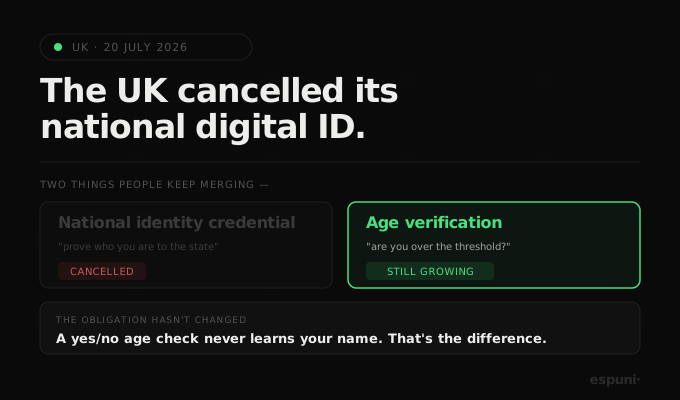
What was cancelled is a government-issued national identity credential — a state document that proves who you are, aimed initially at right-to-work checks and access to public services. It's the "the state issues you an identity" model. What survives is everything around it: the wallet, the trust framework, and the private providers who can issue and verify credentials.
What was not cancelled is the UK's age verification regime under the Online Safety Act. That runs through a market of private, certified Digital Verification Services providers, checking whether a user meets an age threshold for age-restricted content and goods. It has its own trust framework, its own certification deadlines, and — per the government's own sectoral report published two weeks ago — it's one of the fastest-growing segments of the identity sector, with age verification as a use case having doubled among providers in a year.
Those are different problems with different buyers, different legal drivers, and different technology. The identity credential is gone. The age verification market is untouched and still growing. A platform that needs to check age to comply with the Online Safety Act has exactly the same obligation today that it had last week.
The lesson that does carry across
So if the age verification market is unaffected, is there anything here for an operator in the EU under the DSA? Yes — but it's not a technical lesson, and it's not a claim that any one architecture beats another. It's about what earns public acceptance.
The UK government spent months insisting its scheme was designed carefully — that it would not create a single database of everything the state knows about a person, that data would sit across departments, that the user would control what was shared. Whether or not you found those assurances convincing, they didn't decide the outcome. The scheme didn't fall on the details of its architecture. It fell on trust: a large part of the public simply did not want a state identity credential, and no amount of design reassurance moved that.
The Ada Lovelace Institute made the sharp version of this point during the consultation — that legitimacy for a digital identity system has to be earned over time through governance, redress and participation, not declared at the end of a single consultation window. That's the transferable insight, and it applies just as much on the EU side of the Channel.
Why this is quietly reassuring for age verification specifically
Here's the part that matters for anyone building age verification rather than identity.
The thing the UK public rejected was being asked to hold and present a full state identity. Age verification — at least the kind the EU Age Verification Blueprint describes — asks for far less. It doesn't establish who you are. It returns a single boolean: over the threshold, or not. No name, no date of birth, no identity credential to carry.
That's not a claim that one country's system is more private than another's, and it's not a verdict on the UK's design, which reasonable people disagreed about. It's a simpler observation: the less a system asks of a person, the less resistance it tends to meet. A mechanism that confirms "old enough" without establishing identity sits at the low-demand end of that spectrum. The political heat that built up around a national identity credential doesn't obviously transfer to a yes/no age check that never learns your name.
That distinction is easy to lose in a week when "UK scraps digital ID" is the headline. For platforms working out how to meet their obligations — DSA Article 28 in the EU, the Online Safety Act in the UK — the requirement to verify age hasn't changed. What changed is one government's identity card, which was never the same thing.
This article refers to the UK national digital identity scheme cancelled on 20 July 2026, the UK Online Safety Act age verification regime, and the UK Government's Digital Identity Sectoral Analysis Report 2026 (DSIT). The UK operates under a different legal and technical regime from the EU's DSA and EUDI Wallet ecosystem; points about the EU approach are based on the EU Age Verification Blueprint (ageverification.dev).
Sources for this article are linked inline. For the full list of primary sources espuni relies on, see references.